

How to Ask for Closed-Laptop Proof After AI Homework
When AI helps with an assignment, parents and teachers still need closed-laptop proof that the student can explain, defend, and recover the work without the tool open.
By Remix Academics Research
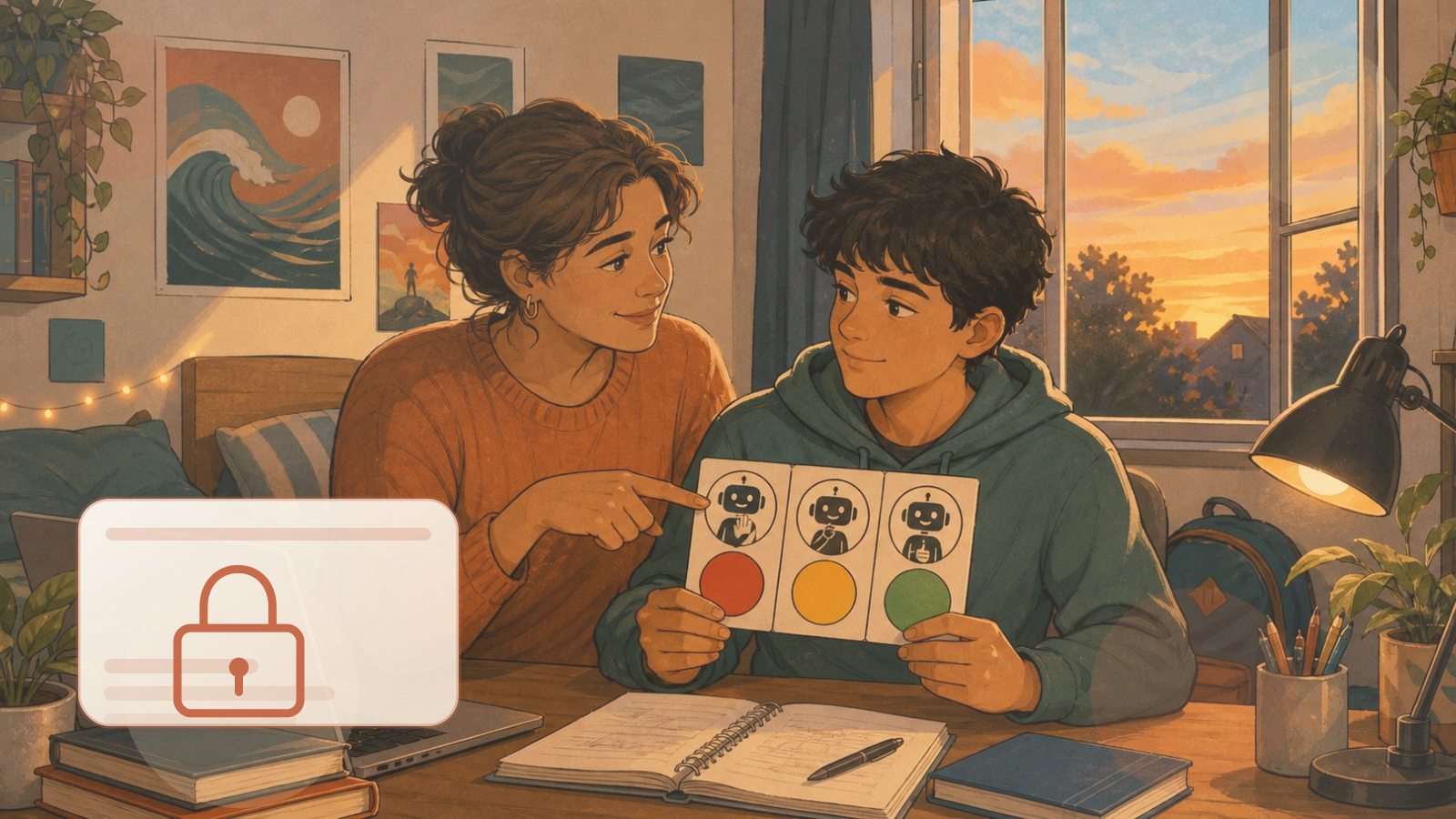
# How to Ask for Closed-Laptop Proof After AI Homework
AI is moving from headline to homework.
That means the parent question has to mature. We cannot stop at, "Did the school allow AI?" We also cannot stop at, "Did my child use the tool?"
The better question is: what can my child still explain when the laptop closes?
That is the closed-laptop proof check.
What is closed-laptop proof after AI homework?
When a student uses AI, a polished answer can arrive before understanding has had time to form. The paragraph looks clean. The study guide looks organized. The slide deck looks finished. But a parent may still be staring at the kitchen table wondering, "Does my child actually know this, or did the tool make it look like they know it?"
That question is not anti-technology. It is pro-learning.
Microsoft's new AI in education report is another sign that AI support, training, and workflow are becoming normal parts of the education conversation. Schools, teachers, and students are going to keep experimenting. At the same time, evidence reviews like Stanford SCALE's work remind us to stay honest: rapid adoption is not the same thing as proven learning impact for every K-12 use case.
Families need a middle move.
Why does explanation matter more than completion?
Try this after an AI-supported assignment:
1. Ask your child to explain the main idea without looking at the screen. 2. Ask what they changed after the AI helped. 3. Ask them to use the idea in a new example.
That is it. Explain it, change it, use it somewhere else.
If your child can do those three things, the tool may have supported real learning. If they cannot, the finished product may be ahead of the understanding.
This matters even more for families outside the default system. Homeschool parents, hybrid families, Black and Brown families navigating uneven support, neurodivergent learners, and families using tutoring or school-choice funds often carry more of the quality-control work at home. They do not just need access to tools. They need evidence that the tool is helping a kid build judgment.
So when a school announces a new AI tool, ask a learning question, not only a policy question.
Where does the tool help?
Where does the student still have to think?
How will the teacher know the difference between a cleaner answer and a stronger learner?
That last question belongs in every parent conference, homeschool co-op, tutoring plan, and AI policy conversation this year.
The future is not going to be tool-free. But our kids still need moments where they can close the laptop, look up, and say, "Here is what I understand."
That is the receipt families should be asking for.
What should parents try this week after an AI-assisted assignment?
Pick one assignment, not the whole school year. If AI helped anywhere in the process, ask for closed-laptop proof before you call the work done.
If you need help turning a school AI policy into a parent question, bring it to Ask Tendi or follow the Remix Report for practical field notes.
Questions Parents Ask ChatGPT About This Issue
### What is closed-laptop proof in AI homework?
It is a check that the student can explain the idea, recover the steps, and defend the answer without reopening the tool that helped generate the work.
### Why should parents ask for closed-laptop proof?
Because completion can hide confusion. The explanation step shows whether the child learned the material or only moved the task to done.
### How can families use closed-laptop proof at home?
Ask the student to summarize the argument, teach the step back to you, or revise one part by hand after the screen is shut.
FACT-CHECK
- Microsoft published a June 24, 2026 AI in education report describing broad adoption and growing demand for support across education.
- Stanford SCALE's 2026 K-12 generative AI evidence work remains a caution flag: adoption is moving faster than strong classroom impact evidence.
- This article does not claim AI is good or bad for every child. It gives parents a practical way to look for learning evidence.
Related Remix Guides
Homeschool Pods and Microschools for Diverse Families
A guide to homeschool pods, microschools, co-ops, and small learning communities for diverse families considering flexible education models.
AI Tools for Homeschool and Hybrid Learning Families
A practical guide to using AI tools in homeschool and hybrid learning with parent oversight, privacy awareness, bias checks, and human support.
AI Tutors vs Human Tutors
A family guide comparing AI tutors, human tutors, academic coaches, and hybrid support models for homeschool and diverse students.
Turn the signal into action
Discuss This With the SEAT Squad.
The Remix Report tracks the shift. SEAT Squad is where families, teachers, and tutors turn it into questions, referrals, support, and better learning decisions.
Related Articles
An Indigenous Pedagogy Primer every homeschool family should read
A framework from Māori and First Nations traditions that centers learning as relational before it is informational.
guideMeet the Washingtons: building a learning OS from a Baltimore rowhouse
One household. Three kids. One learning architect. A real family figuring it out in real time.
guideAI Literacy Without Outsourcing Thinking: The New Family Skill
The 2026 AI literacy conversation is landing on one clear principle: kids need to learn AI, but they also need deliberate practice in thinking without it.