
Parents Are Not Anti-AI. They Are Anti-Mystery.
Families need clear AI boundaries, data transparency, human checks, and proof that kids can still think without the tool.
By Remix Academics Research
# Parents Are Not Anti-AI. They Are Anti-Mystery.
A parent can support AI in school and still want to know what the tool is doing to their child's learning.
That is the real signal right now. The public argument keeps getting flattened into two camps: ban the tools or rush them into every classroom. But families are living in a more complicated middle. They know AI will be part of work, college, creativity, and daily life. They also know a child can use AI to skip the thinking, hide confusion, share data, or get feedback no adult ever checked.
That is not anti-technology. That is parent judgment.
EdChoice's June 2026 polling shows the tension clearly: 60 percent of school parents support AI in the classroom, while about one-third are extremely or very concerned about AI's effects on their child's learning. National Parents Union is moving in the same direction with a family-facing AI Policy Tool built around a traffic-light framework. And the FCC's June E-Rate draft asks whether federally funded school networks should do more to protect children, limit harmful screen use, and empower parents and teachers.
The common thread is not fear. It is visibility.
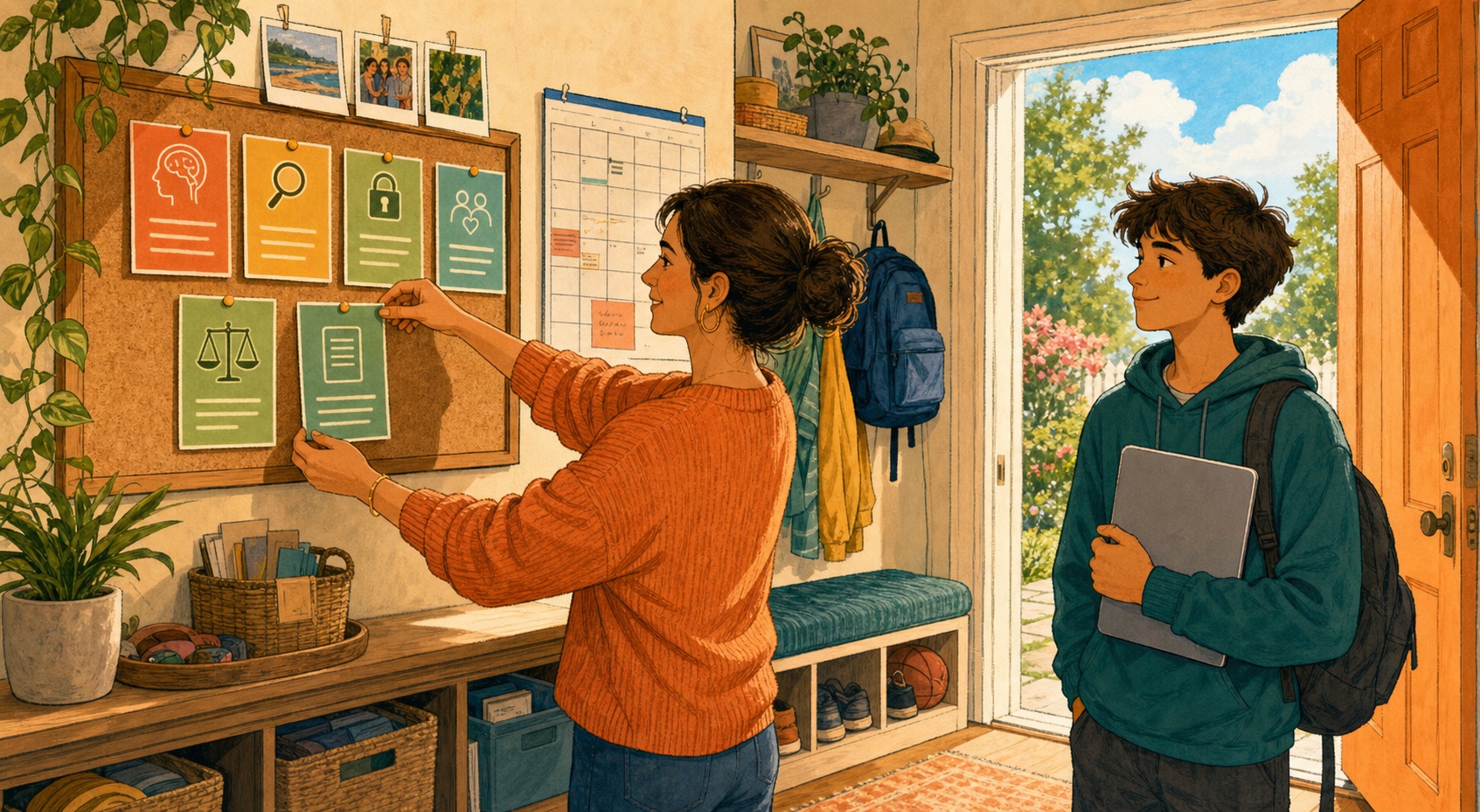
Parents need a boundary map before AI becomes normal in their child's school day. Not a 40-page policy. Not a vendor promise. A simple way to ask four questions:
1. What job is this tool doing? 2. What student data does it touch? 3. What human check stays in place? 4. What should my child still be able to do without the tool?
That last question matters most. If AI helps a student brainstorm, practice, translate, organize, or get feedback, say that plainly. If it replaces the actual thinking, say that too. A traffic-light policy only works when families can understand where the red, yellow, and green lines are in real homework, not just in district language.
NYC Public Schools offers one useful model and one warning. Its ERMA process requires vendors to disclose AI capabilities, prohibits student data from being used to train AI models, and sets transparency expectations for families and students. But NYC also says ERMA does not yet evaluate algorithmic bias, equity impact, or instructional effectiveness. That distinction is important. Privacy review is not the same thing as learning proof.
This is where families outside the default need language early. Black, Brown, neurodivergent, disabled, immigrant, and homeschool-adjacent families already know what happens when a system makes decisions first and explains later. AI does not create that problem, but it can speed it up.
The move this week is not to panic. Pick one AI tool, school app, or homework habit and ask the boundary-map questions. If the answer is fuzzy, that is the conversation to bring to the teacher, school board, co-op, or home plan.
Parents are not asking for a future without technology. They are asking for a learning day they can actually see.
FACT-CHECK
- FCC circulated a June 2026 E-Rate draft seeking comment on student learning outcomes, online safety, screen time, and parent, guardian, and teacher empowerment: https://docs.fcc.gov/public/attachments/DOC-422168A1.pdf
- National Parents Union launched an AI Policy Tool for families with a Traffic Light Framework on May 27, 2026: https://nationalparentsunion.org/2026/05/27/national-parents-union-launches-first-of-its-kind-ai-policy-tool-for-families/
- EdChoice's June 2026 polling reports 60 percent of school parents support AI in the classroom, while about one-third are extremely or very concerned about AI's effect on their child's learning: https://www.edchoice.org/research/the-public-parents-and-k-12-education-june-2026-polling/
- NYC Public Schools' ERMA guidance says the process reviews privacy and security, requires AI capability disclosure, prohibits student-data training, and does not yet evaluate bias, equity impact, or instructional effectiveness: https://www.schools.nyc.gov/about-us/vision-and-mission/artificial-intelligence/guidance-on-artificial-intelligence
CTA: Bring one AI boundary question into SEAT Squad this week, or ask Tendi to help turn a school AI policy into a family plan.
Related Remix Guides
AI Safety for Students
A practical guide to AI safety for students, including privacy, bias, hallucinations, age-appropriate use, supervision, and learning integrity.
Homeschool Pods and Microschools for Diverse Families
A guide to homeschool pods, microschools, co-ops, and small learning communities for diverse families considering flexible education models.
AI Tools for Homeschool and Hybrid Learning Families
A practical guide to using AI tools in homeschool and hybrid learning with parent oversight, privacy awareness, bias checks, and human support.
Turn the signal into action
Discuss This With the SEAT Squad.
The Remix Report tracks the shift. SEAT Squad is where families, teachers, and tutors turn it into questions, referrals, support, and better learning decisions.
Related Articles
An Indigenous Pedagogy Primer every homeschool family should read
A framework from Māori and First Nations traditions that centers learning as relational before it is informational.
guideMeet the Washingtons: building a learning OS from a Baltimore rowhouse
One household. Three kids. One learning architect. A real family figuring it out in real time.
guideAI Literacy Without Outsourcing Thinking: The New Family Skill
The 2026 AI literacy conversation is landing on one clear principle: kids need to learn AI, but they also need deliberate practice in thinking without it.